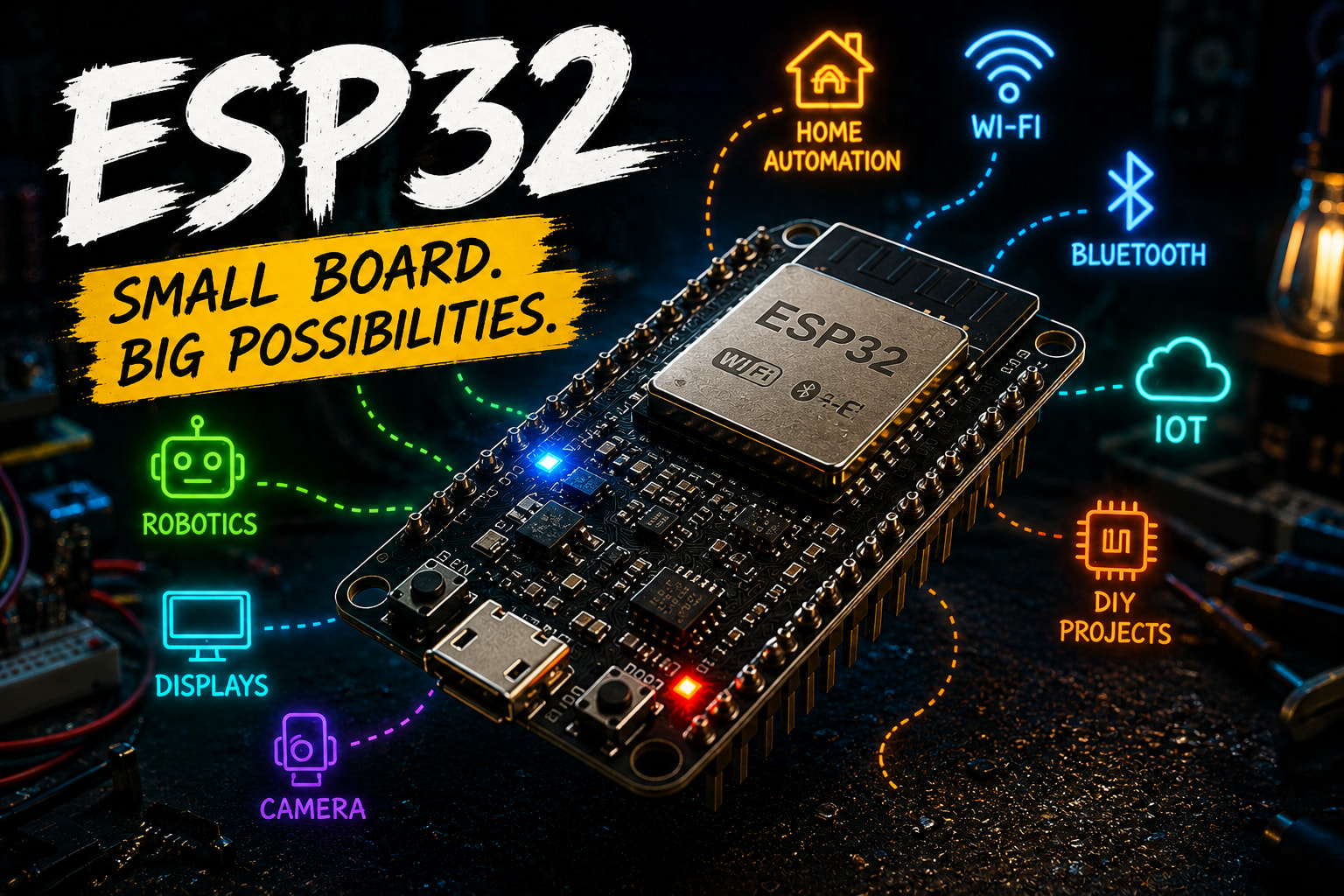
ESP32 - The Tiny Microcontroller With Huge Capabilities
ESP32 is a family of microcontrollers made by Espressif Systems that has become almost a standard for DIY projects and home automation over the past few years.
The reason for its popularity is simple: for a very low price, you get Wi-Fi, Bluetooth, solid performance, and a large set of peripherals in a single chip.
For most hobby projects, that is more than enough.
And honestly, once you start using ESP32, it somehow ends up in everything.
A Bit of History
Before ESP32, the ESP8266 was extremely popular. It was cheap and surprisingly powerful for its time, but it had limitations in memory, peripherals, and overall stability.
ESP32 became the natural evolution of that idea:
- dual-core CPU
- more memory
- Bluetooth support
- improved peripherals
- more stable Wi-Fi
- more GPIO
- low-power modes
After its release, people started putting Wi-Fi into almost everything:
- home automation
- weather stations
- robots
- lighting systems
- telemetry devices
- sensor hubs
- custom control panels
Probably at least one toaster too.
Today there are several ESP32 variants available:
- ESP32
- ESP32-S2
- ESP32-S3
- ESP32-C3
- ESP32-C6
Each version targets different use cases. For example:
- the S3 is popular for USB and display-related projects
- the C3 is known for low power consumption and its RISC-V architecture
- the C6 adds Wi-Fi 6 support
Why DIY Developers Love ESP32
Low Cost
Development boards are extremely affordable, which makes experimentation much less stressful.
That matters a lot when learning - you can burn something, solder incorrectly, or redesign a project without feeling like you destroyed a month’s salary.
Built-In Wi-Fi and Bluetooth
No additional networking modules are required.
ESP32 can:
- host a web interface
- send sensor data
- connect to smartphones
- integrate with Home Assistant
- transmit telemetry
- be controlled remotely
For many home projects, that alone is enough to start feeling dangerously productive.
Enough Performance for Serious Projects
ESP32 is no longer just an “Arduino alternative.”
Depending on the model, it can:
- run multiple tasks simultaneously
- work with displays
- process audio
- control motors
- emulate USB devices
- stream data
- run lightweight ML models
ESP32-S3 projects with USB HID and displays are especially fun.
There is something mildly cursed about a tiny board pretending to be a keyboard, mouse, web server, and display controller all at once.
Huge Ecosystem and Community
There are already libraries available for almost everything:
- OLED displays
- sensors
- motors
- LED strips
- cameras
- GPS
- NRF24
- LoRa
- touch panels
If someone has already connected a weird sensor to ESP32 before, chances are the code is sitting somewhere on GitHub inside a repository called:
final_fixed_v2_REAL_last
Where Most Beginners Start
Most people use:
That is more than enough for beginners.
Useful resources:
Wokwi is especially useful because it allows you to test ESP32 projects directly in the browser without owning the hardware.
Perfect for experimenting, learning, debugging, or looking busy during long meetings.
Common Beginner Mistakes
Power Supply Problems
ESP32 can be sensitive to unstable power, especially when Wi-Fi is active.
Typical symptoms include:
- random resets
- boot loops
- freezing
- Wi-Fi disconnects
This becomes especially noticeable when using:
- servos
- motors
- RF modules
- LED strips
Using a proper power supply and capacitors near heavy loads is strongly recommended.
Because when Wi-Fi starts transmitting, tiny power supplies sometimes give up emotionally.
Incorrect GPIO Usage
Some GPIO pins affect the boot process.
Connecting the wrong hardware to them can cause:
- flashing failures
- endless rebooting
- startup issues
It is always a good idea to check the pinout for your specific board before wiring everything.
ESP32 is powerful, but occasionally dramatic.
Missing Common Ground
One of the most common beginner mistakes.
If devices exchange signals but do not share a common ground, behavior can become completely unpredictable.
At some point, almost everyone asks:
“Do I really need common ground?”
Usually right before spending two hours debugging nonsense.
Starting With Overly Complex Projects
Many beginners try to build something massive right away.
It is much more effective to begin with simple projects:
- blinking LEDs
- OLED displays
- web servers
- sensor reading
- relay control
Starting with an autonomous AI drone swarm is generally not recommended.
At least not on the first weekend.
Interesting ESP32 Project Ideas
Wi-Fi Device Control
One of the most popular use cases:
- relays
- lighting
- sensors
- Home Assistant integration
Simple, useful, and surprisingly addictive.
USB HID Devices
ESP32-S3 can be used to build:
- macro pads
- keyboards
- mice
- custom control panels
Perfect for productivity setups or extremely overengineered volume controls.
FPV and Telemetry
ESP32 works well for:
- telemetry reception
- displaying flight data
- Wi-Fi streaming
- ground stations
Especially useful for custom DIY setups where commercial hardware becomes either too expensive or too boring.
Cameras and Computer Vision
ESP32-CAM can handle:
- motion detection
- basic object recognition
- video streaming
- remote monitoring
A tiny microcontroller running computer vision still feels slightly illegal considering the price.
Mesh Networks
ESP32 can operate in mesh mode, allowing devices to communicate without internet access.
This is useful for autonomous systems, field projects, experiments, or just building something that looks cyberpunk for no practical reason.
Final Thoughts
ESP32 became popular for good reasons.
It combines:
- low cost
- solid capabilities
- beginner-friendly development
- a huge community
- impressive flexibility
You can use it to build anything from a simple temperature sensor to a complex system with displays, networking, and multiple peripherals.
Most people start with:
“I just want to blink an LED.”
A few months later they somehow end up designing custom PCBs at 2 AM while explaining power supply noise to their friends.
That is basically the ESP32 experience.