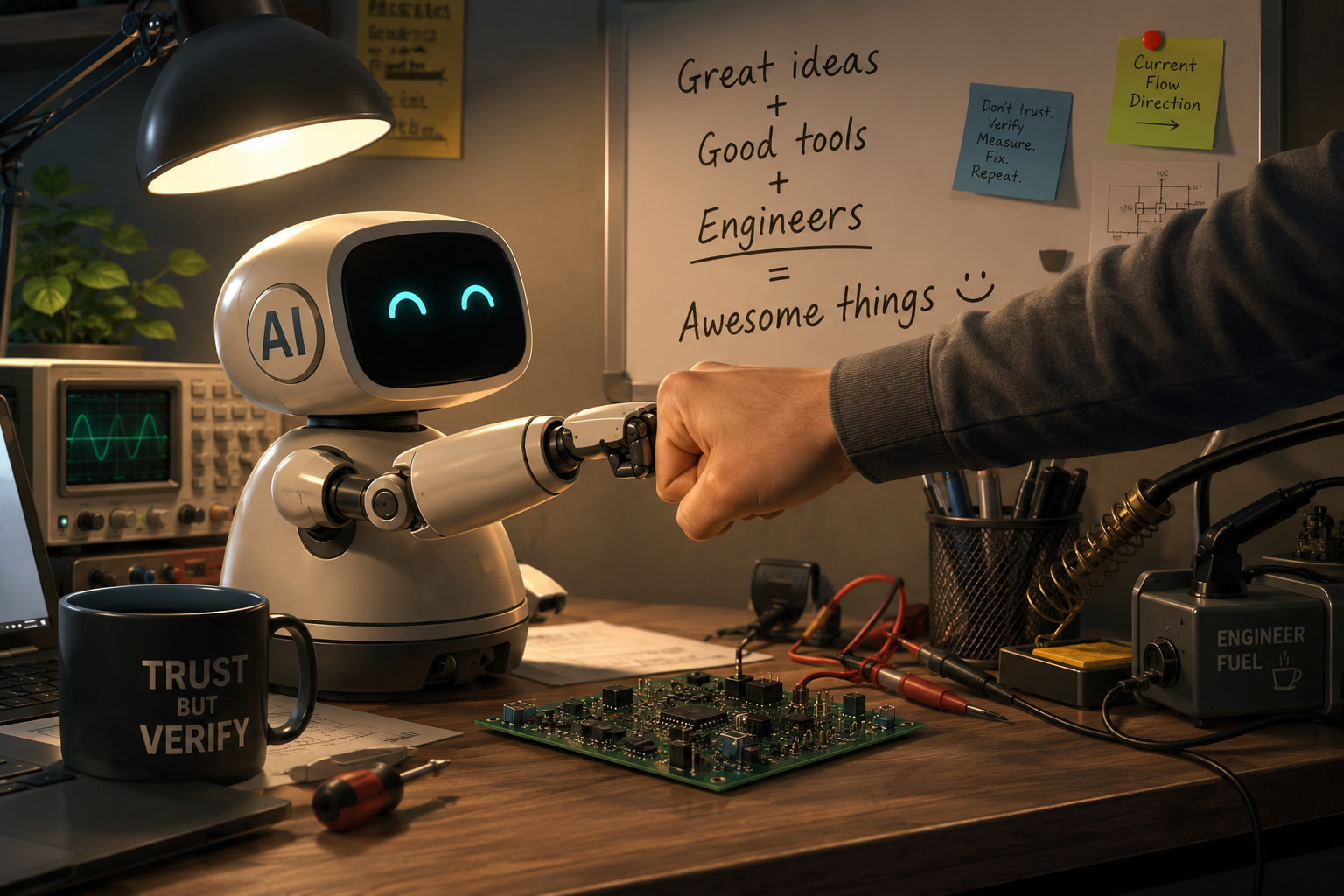
A lot of engineers are afraid of AI for the same reason electricians are afraid of “temporary wiring”: it looks useful right before something catches fire.
The internet keeps swinging between two extremes. One group says AI will replace every engineer on Earth by next Tuesday. The other group treats AI like a glorified autocomplete that can barely generate a correct resistor divider. Reality, as usual, sits somewhere in the middle - quietly soldering wires while everyone argues.
AI is not replacing engineers.
It is replacing the part of engineering that feels like searching through fifteen forum threads from 2013 written by a guy named “xXDarkPCBMasterXx”.
That’s an important distinction.
A good engineer is not valuable because they remember pinouts or can manually rewrite boilerplate code for the hundredth time. A good engineer is valuable because they understand systems, tradeoffs, failure modes, physics, manufacturing limitations, timing, thermal behavior, safety, and the horrifying creativity of real-world bugs.
AI does not magically gain intuition just because it can generate 400 lines of C++ in three seconds.
Ask AI to design a power supply and it may produce something that looks correct. Sometimes it even works. Right until the MOSFET enters the afterlife because nobody checked switching losses or gate ringing.
AI is incredibly confident. Electronics are incredibly unforgiving. This combination is educational.
But used correctly, AI becomes one of the most powerful engineering tools we’ve ever had.
Need to prototype a communication protocol? AI helps.
Need to generate starter firmware? AI helps.
Need to explain why your SPI bus behaves like it’s haunted? AI surprisingly helps there too.
It accelerates iteration. That’s the real revolution.
A decade ago, building something meant spending half your time digging through documentation and the other half discovering that the documentation lied. Now you can move from idea to prototype absurdly fast. The engineer still makes the decisions - AI just removes friction.
And friction was always the real productivity killer.
The funny part is that experienced engineers often get more value from AI than beginners do. A beginner sees generated code and thinks: “Amazing, it works.”
An experienced engineer sees the same code and thinks:
“Interesting. Three hidden race conditions, two timing issues, undefined behavior, but the architecture idea is actually decent.”
That’s why AI amplifies skill instead of replacing it.
A CNC machine didn’t eliminate machinists. Oscilloscopes didn’t eliminate electronics experts. Fusion 360 didn’t eliminate mechanical engineers. And AI won’t eliminate people who actually understand what they’re building.
What will disappear are workflows built entirely around repetitive intellectual labor.
Engineers who refuse to use AI may eventually end up like developers who proudly avoided Google search in 2008. Technically admirable. Commercially questionable.
The healthiest mindset is simple:
Treat AI like a very fast intern.
An intern who never sleeps.
An intern who read the entire internet.
An intern who occasionally hallucinates capacitor values from another dimension.
You still verify the work.
Because in real engineering, reality is the final compiler.
The PCB either boots or it doesn’t.
The drone either flies or becomes modern art.
The power supply either regulates voltage or generates emotional growth.
And no language model can bypass physics.